Predictive analytics can support better planning, but forecasts are easy to misuse. A model output is not a decision. It is an input into a decision process.
Common mistakes
Teams often train on weak historical data, ignore structural changes, overfocus on one accuracy metric, or fail to explain uncertainty. Another common mistake is building a forecast without defining who will use it and what action it supports.
The predictive analytics and machine learning service frames predictive work around decision support, not model output alone.
Forecasts need operating context
A useful forecast includes assumptions, confidence, refresh cadence, and review ownership. That makes it easier for teams to act without overtrusting the number.
Accuracy is not the only success metric
A forecast can be statistically accurate and still fail operationally if it arrives too late, uses unavailable data, ignores capacity constraints, or does not connect to a decision. The team should define how the prediction will change planning behavior.
For example, a demand forecast may support staffing, stock planning, or campaign timing. Each use case needs different lead time, error tolerance, and explanation.
Make uncertainty visible
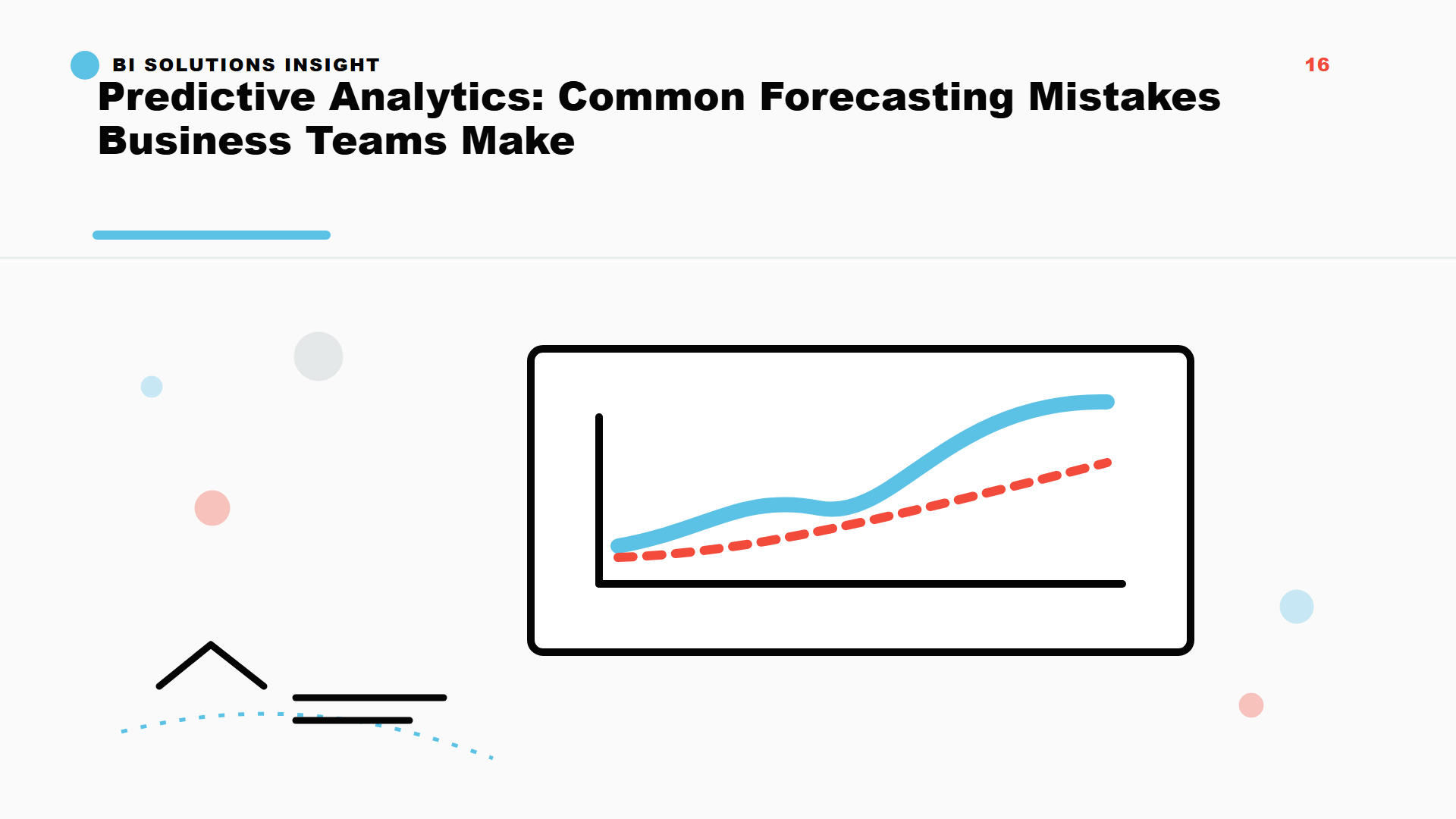
Business teams often want one number, but forecasts are more useful when they show uncertainty. Ranges, scenarios, and assumptions help teams avoid treating the model as certainty.
This is also important for AI adoption. People trust predictive analytics more when they understand what the model knows, what it does not know, and when human judgment should override it.
FAQ
What is the biggest forecasting mistake? The biggest mistake is building a model before defining the decision it supports and the action the business will take.
Should forecasts show a single number or a range? Ranges are often better because they communicate uncertainty and help teams plan for multiple scenarios.
How does BI Solutions approach predictive analytics? The work starts with business context, data quality, assumptions, review rules, and how the prediction will support a decision.